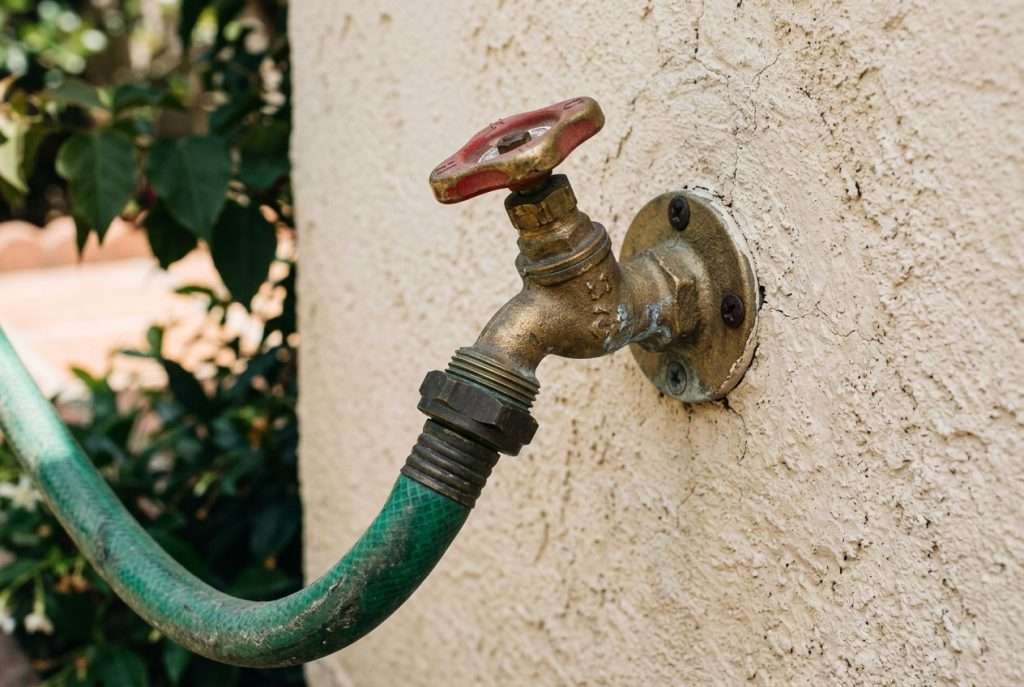
A hose bib is the outdoor faucet mounted on the exterior wall of your house — the valve you screw a garden hose onto. You might hear it called a spigot, sillcock, or outdoor faucet. They all mean the same thing: a valve that connects your interior water supply to the outside of the building.
Most homes in Southern California have at least one, usually near the garage or on a side wall. They look simple, but a leaking or frozen hose bib can waste hundreds of gallons of water or, in the worst case, burst a pipe inside the wall.
What Are the Different Types of Hose Bibs?
Standard hose bib. The most common type. A brass or chrome valve body threads into the water supply pipe at the wall. The handle turns a rubber washer against a seat to stop flow. Cheap, reliable, and easy to find at any hardware store. The tradeoff is that the shutoff point sits right at the wall surface, which makes it vulnerable to freezing.
Frost-free (anti-siphon) hose bib. The handle is at the wall, but the valve seat sits 6 to 12 inches back inside the wall, in the heated space. When you shut it off, water drains out of the exposed section so nothing is left to freeze. These are standard in cold climates. In Southern California they’re less common, but homes in inland valleys like the San Gabriel Valley and Upland do see overnight temperatures below freezing a few times each winter — enough to crack an unprotected standard bib.
Yard hydrant. A freestanding post, usually in a yard or garden, connected to a buried supply line. The shutoff is below the frost line. More common on rural properties or large lots.
All three connect to your home’s water supply line, and all can develop the same basic problems: leaks, corrosion, and freeze damage.
Why Is My Hose Bib Leaking?
A hose bib that drips from the spout when closed usually has a worn rubber washer. This is the most common failure — the washer compresses over time and stops sealing against the valve seat.
Other causes:
- Cracked body. If water froze inside the valve, the brass or copper can crack. You might not notice until spring when you turn it back on and water sprays from a split in the body or from inside the wall.
- Corroded valve seat. Hard water and mineral deposits pit the seat surface, so even a new washer won’t seal completely.
- Loose packing nut. Water leaking around the handle stem (rather than from the spout) usually means the packing nut needs a quarter-turn tightening, or the packing washer behind it needs replacing.
If water is coming from inside the wall rather than the faucet itself, the supply pipe or the connection behind the hose bib may be damaged. That’s a sign to find the source of the leak before the damage spreads.
How Do I Fix a Leaking Hose Bib?
For a spout drip (the most common fix):
- Shut off the water supply to the hose bib. There’s usually an interior shutoff valve on the supply line, often in the garage or basement.
- Open the hose bib to drain remaining water.
- Remove the handle screw and pull off the handle.
- Unscrew the packing nut with a wrench, then pull out the stem assembly.
- Remove the old washer from the end of the stem. Bring it to the hardware store to match the size — hose bib washers are not all the same.
- Install the new washer, reassemble, restore water, and test.
For a handle leak, try tightening the packing nut a quarter turn clockwise. If that doesn’t stop it, replace the packing washer behind the nut.
This fix takes 15 to 30 minutes with basic tools. If the valve body itself is cracked, though, you’ll need to replace the entire hose bib.
How Do I Prevent My Hose Bib from Freezing?
Southern California doesn’t get the deep freezes that the Midwest does, but it doesn’t take much. Water freezes at 32°F, and interior-valley cities like Arcadia, Upland, and Pasadena regularly dip into the low 30s on clear winter nights.
To protect a standard hose bib:
- Disconnect the hose. A connected hose traps water in the valve body and prevents it from draining. This is the number-one cause of frozen hose bibs in mild climates where homeowners don’t expect a freeze.
- Shut off the interior valve. Close the shutoff valve on the supply line inside your house, then open the hose bib to drain the remaining water.
- Use an insulated cover. Foam faucet covers from any hardware store cost a few dollars and add a buffer against overnight cold.
- Upgrade to frost-free. If your hose bib has frozen before, a frost-free model eliminates the problem by moving the shutoff point inside the wall. This is a residential plumbing job that typically involves cutting into the exterior wall and soldering a new valve onto the supply line.
Should I Repair or Replace My Hose Bib?
Repair makes sense when:
- The valve body is intact (no cracks, no corrosion holes).
- The leak is from the spout or handle and stops with a new washer or packing.
Replace when:
- The body is cracked from freezing or age.
- The valve seat is too pitted to seal, even with a new washer.
- You have a standard bib and want to upgrade to frost-free.
- The bib is old enough that replacement parts are hard to find.
A leaky faucet that drips steadily can waste over 3,000 gallons per year. If a washer swap doesn’t fix it, replacing the whole unit usually makes more sense than repeated repairs.
How Much Does Hose Bib Replacement Cost?
For a straightforward swap (same type, accessible plumbing, no wall repair needed), most plumbers charge in the range of $150 to $350. A frost-free upgrade that requires cutting into stucco or siding and soldering new copper runs higher, often $250 to $500 depending on access and pipe material.
Factors that affect cost:
- Access. If the supply pipe is easy to reach from the interior, the job is faster. Pipes buried in a finished wall cost more.
- Pipe material. Copper soldering takes more skill and time than a threaded connection or PEX crimp.
- Backflow prevention. Some local codes require an anti-siphon valve on outdoor faucets. If yours doesn’t have one, the plumber may need to add it during replacement.
These are general ranges, not quotes. The actual cost depends on your specific setup.
When Should You Call a Plumber?
A washer replacement is a reasonable DIY job. Beyond that, consider calling a professional when:
- Water is leaking inside the wall, not just from the faucet.
- The hose bib body is cracked or corroded through.
- You want to upgrade to a frost-free model (requires cutting the wall and working with copper or PEX supply lines).
- The supply pipe behind the bib is galvanized, corroded, or hard to access.
- Your area requires a backflow preventer and you’re not sure whether yours is compliant.
A plumber can also check whether the water line behind the wall is in good shape or whether it’s time for a broader repair.
If you need help with a hose bib repair or replacement, call Western Rooter & Plumbing at (626) 448-6455 or schedule service online through our website.