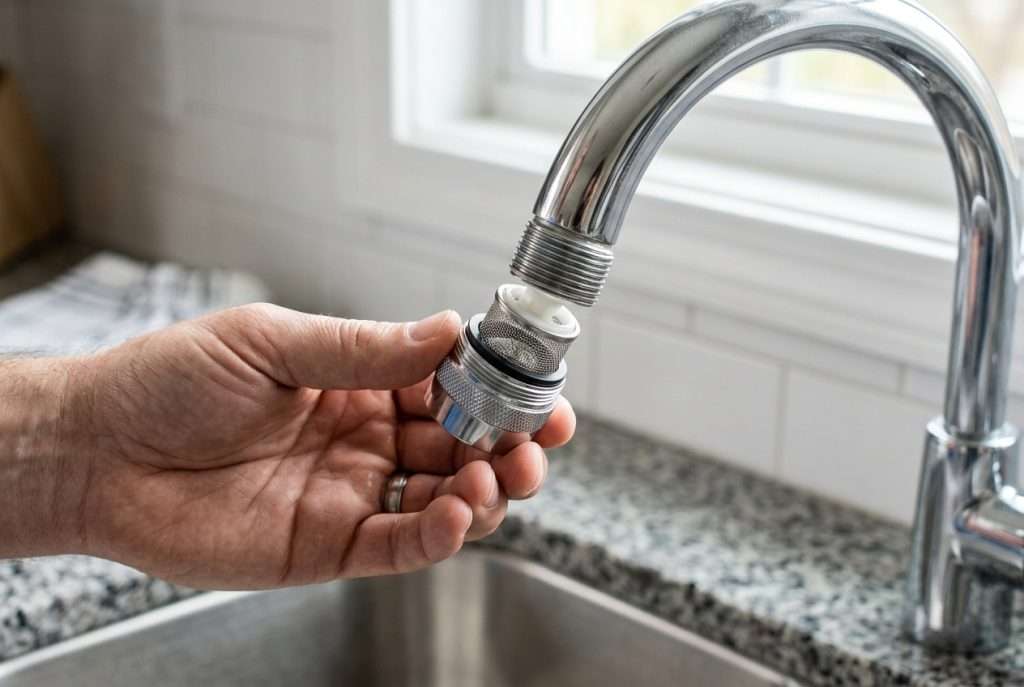
A faucet aerator is the small screen-and-housing assembly that screws onto the tip of your faucet spout. It mixes air into the water stream, which reduces splashing, controls flow rate, and cuts water use without making the pressure feel noticeably lower. Most kitchen and bathroom faucets come with one installed from the factory.
If your faucet stream has gone weak, uneven, or started spraying sideways, the aerator is the first thing to check, and it’s one of the easiest plumbing fixes you can do yourself.
How Does a Faucet Aerator Work?
Inside the housing, a stack of fine mesh screens breaks the single stream of water into many smaller streams and introduces tiny air bubbles. This does three things:
- Reduces water flow from an unrestricted 3–5 GPM down to about 2.2 GPM (the federal standard since 1994) or as low as 1.0 GPM on WaterSense-labeled models.
- Prevents splashing by softening the stream so it doesn’t bounce off dishes or your hands.
- Filters small debris. The screens catch sediment, mineral flakes, and pipe scale before they reach your glass.
The aerator restricts volume, not pressure. That’s why a faucet with a working aerator still feels strong even though less water is actually flowing.
How Do You Know If Your Faucet Aerator Is Clogged?
A clogged aerator shows up gradually. Watch for:
- Reduced water flow that gets worse over weeks or months
- An uneven or crooked stream that doesn’t come out straight
- Spraying or misting around the edges of the stream
- Slow filling when you’re trying to fill a pot or sink
- One weak faucet while others are fine. That points to the aerator on that specific faucet, not a whole-house issue
In Southern California, hard water accelerates this. Calcium and mineral deposits build up on the screens faster than in soft-water areas, so aerators in the San Gabriel Valley or Inland Empire may need cleaning every 6–12 months rather than once a year or two.
How to Remove a Faucet Aerator
Standard External Aerators
Most aerators unscrew by hand — turn counterclockwise (looking up at the spout). If mineral buildup has locked it in place:
- Wrap a rubber jar gripper or a strip of duct tape around the aerator for traction.
- Turn counterclockwise. If it still won’t budge, wrap the aerator with a rag and use pliers (the rag protects the finish from scratches).
- Once loose, unscrew by hand and set the housing, screens, and washer on the counter in the order they came out so you can reassemble correctly.
Cache (Hidden) Aerators
Some newer faucets have a recessed or “cache” aerator that sits inside the spout rather than on the outside. You won’t see external threads. These require a special cache aerator key — a small plastic tool that inserts into the spout and grips the aerator so you can twist it out. Most hardware stores carry them, and some faucet manufacturers include one in the box. Check your faucet brand’s website if you’re not sure which key fits.
How to Clean a Faucet Aerator
- Remove the aerator (see above).
- Disassemble the housing, screens, mixer disc, and rubber washer. Take a quick photo first so you remember the order.
- Rinse each piece under running water and use an old toothbrush to scrub away sediment and mineral crust.
- For stubborn calcium deposits, soak the parts in white vinegar for 30–60 minutes. The acid dissolves the mineral scale.
- Rinse again, reassemble, and screw the aerator back on. Hand-tight is enough. Overtightening can crack the housing or damage the washer.
If the screens are torn, corroded, or warped, replace the aerator. They cost a few dollars at any hardware store.
What Size Faucet Aerator Do You Need?
Faucet aerators come in three common thread sizes:
- Regular (15/16″ outside diameter). The most common on standard kitchen and bathroom faucets. Male threads on the aerator, female threads inside the spout.
- Junior (13/16″ outside diameter). Slightly smaller, usually found on bathroom faucets and some compact kitchen faucets.
- Cache/hidden. No external threads. Size varies by manufacturer. Bring your old aerator (or the faucet model number) to the hardware store to match it.
If you’re unsure, unscrew the old aerator and bring it with you. The thread size and flow rate (in GPM) are usually stamped on the housing.
You also choose the flow rate. Standard is 2.2 GPM. Low-flow options range from 0.5 to 1.5 GPM. For a kitchen faucet where you fill pots regularly, 1.5–2.2 GPM is practical. For a bathroom sink where you’re washing hands, 1.0 GPM works fine and saves water.
How Often Should You Replace a Faucet Aerator?
With regular cleaning, an aerator lasts several years. Replace it when:
- The screens have holes, tears, or heavy corrosion that cleaning doesn’t fix
- The rubber washer is cracked or flattened and the aerator drips or wobbles
- Flow is still poor after a thorough cleaning
- The threads are stripped and the aerator won’t seat properly
In hard-water areas, plan on cleaning every 6–12 months and replacing every 2–3 years. In soft-water areas, you may get 5+ years from one aerator.
Can You Use a Faucet Without an Aerator?
Technically, yes. The faucet will still deliver water. But you’ll notice:
- More splashing. The unrestricted stream hits harder and sprays off surfaces.
- Higher water use. Without the flow restriction, a standard faucet runs at 3–5 GPM instead of 2.2.
- No debris filtering. Sediment and pipe scale pass straight through.
Running without one temporarily while you’re cleaning or replacing it is fine. Long-term, there’s no good reason to leave it off.
When Low Water Pressure Isn’t an Aerator Problem
A clogged aerator is the most common cause of low flow at a single faucet, but it’s not the only one. If cleaning or replacing the aerator doesn’t help, the issue might be:
- A partially closed shutoff valve under the sink
- Corroded supply lines, especially in older homes with galvanized pipe
- A failing pressure regulator affecting the whole house
- A problem at the water main or municipal supply
If every faucet in the house is weak, the aerator isn’t to blame. That’s a system-wide issue. You can troubleshoot low water pressure with a few checks, but if the cause isn’t obvious, it’s worth having a plumber take a look.
Also, if you notice water leaking from the base of the faucet or from the handles while troubleshooting, that’s a separate issue: worn cartridges, O-rings, or valve seats, not the aerator. A bathroom faucet leaking from the base needs a different fix.
If cleaning or replacing the aerator doesn’t solve the problem, call Western Rooter & Plumbing at (626) 448-6455 or schedule service online through our website.