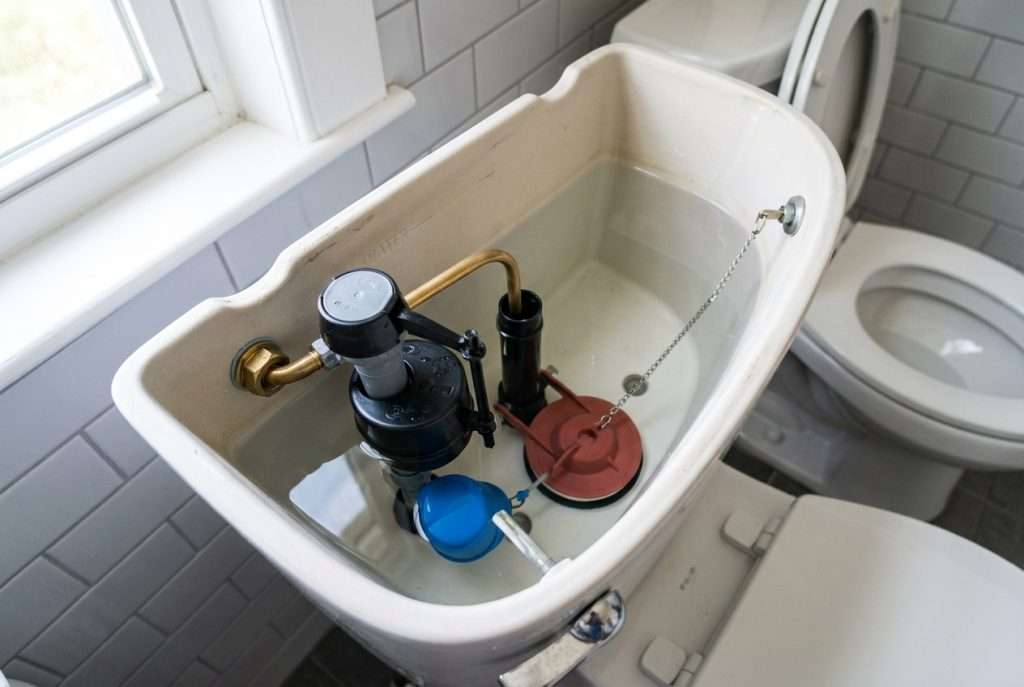
Most toilet noises point to one of three parts: the fill valve, the flapper, or the supply line. A hissing toilet usually has a worn fill valve. A toilet that cycles on and off by itself has a leaking flapper. Whistling typically means the fill valve is old or the supply line is partially restricted. Here’s how to figure out which noise you’re dealing with and what to do about it.
What Different Toilet Noises Mean
A quick reference:
- Hissing — water forcing through a worn or dirty fill valve
- Whistling — vibration in an older ballcock-style fill valve or a partially closed supply valve
- Running water (constant) — flapper not sealing against the flush valve seat
- Cycling on and off every few minutes — slow flapper leak draining the tank, triggering the fill valve
- Banging or thudding — water hammer in the supply lines, not actually the toilet itself
- Gurgling — usually a vent or drain issue, not a toilet part problem
If you hear banging or gurgling, those involve the plumbing system beyond the toilet. The sections below focus on the noises that originate inside or around the toilet itself.
Why Is My Toilet Hissing?
A hissing sound means water is being forced through a narrow opening. The most common cause is a worn diaphragm or seal inside the fill valve. Over time — typically 5 to 7 years — the rubber parts inside a fill valve degrade, and water starts leaking through instead of shutting off cleanly.
Other causes:
- Debris in the fill valve. Sediment or mineral scale (common in areas with hard water, including much of the San Gabriel Valley) can lodge in the valve and prevent a full seal. Removing the cap and rinsing the valve sometimes fixes this.
- Supply valve not fully open. If the shutoff valve behind or below the toilet is partially closed, water has to squeeze through a narrow gap, which produces hissing. Turn it fully counterclockwise to open it all the way.
If rinsing the valve and opening the supply line fully doesn’t stop the hiss, the fill valve likely needs replacement. Our guide on replacing a toilet fill valve walks through the process.
Why Does My Toilet Make Noise After Flushing?
Some noise after a flush is normal — that’s the fill valve refilling the tank. It should last 30 to 60 seconds and stop. If the noise continues longer than a minute or two, something isn’t shutting off properly.
Common reasons for prolonged post-flush noise:
- Flapper isn’t sealing. A warped or mineral-crusted flapper lets water leak from the tank into the bowl. The fill valve keeps running to compensate. You can test this: put a few drops of food coloring in the tank and wait 15 minutes without flushing. If color appears in the bowl, the flapper leaks.
- Fill valve not shutting off. The float may be set too high, causing water to drain into the overflow tube. Adjust the float so the water level sits about half an inch below the top of the overflow tube.
- Refill tube inserted too far into the overflow. If the small refill tube is pushed down into the overflow tube instead of clipped above the rim, it can create a siphon that keeps pulling water.
A toilet that won’t stop running wastes water constantly. If you’ve had a running toilet for a while, it’s probably showing on your water bill.
Why Does My Toilet Make Noise When No One Is Using It?
This is called “phantom flushing” or “ghost flushing.” You hear the fill valve kick on for a few seconds every 10 to 30 minutes, even though nobody flushed.
The cause is almost always a slow leak in the flapper. The tank loses water gradually until the fill valve’s float drops enough to trigger a refill cycle. Then it tops off, the leak continues, and it cycles again.
The EPA estimates a continuously running toilet can lose up to 200 gallons per day. A slow phantom-flush leak wastes less, but it adds up over weeks.
Replacing the flapper is a 10-minute job and usually costs under $10 in parts.
Why Is My Toilet Whistling?
A high-pitched whistle during or after flushing usually comes from an older ballcock-style fill valve — the kind with a float ball on a metal arm. As water rushes past the aging internal parts, the valve vibrates and produces a whistling or squealing sound.
Other potential causes:
- Partially closed supply valve — same mechanism as hissing, but at a frequency that produces a whistle instead
- High water pressure — if your home’s water pressure is above 80 psi, it can cause fill valves to vibrate. A pressure gauge on a hose bib will tell you where you stand. If pressure is consistently high, a pressure-reducing valve may be needed.
Replacing an old ballcock valve with a modern float-cup fill valve usually eliminates the whistle. The newer valves are quieter and more reliable.
Can a Noisy Toilet Run Up Your Water Bill?
Yes. Any noise that indicates running or leaking water means water is being used.
- A stuck-open flapper can waste 200+ gallons per day — more than $50/month in many Southern California water districts.
- A phantom flush cycle every 15-20 minutes adds a few gallons each time, totaling 50-100+ gallons per day depending on severity.
- A hissing fill valve that’s partially stuck open bleeds water into the overflow tube continuously.
If you notice your water bill increasing without an obvious explanation, check your toilets. Quietly running toilets are one of the most common causes of unexplained water use in a home.
Which Toilet Noises Are Easy DIY Fixes?
Most toilet noise problems are fixable without a plumber:
Replace the flapper — fixes phantom flushing, running water, and most post-flush noise. Universal flappers cost $5-$10 at any hardware store. Make sure to match the size (2-inch or 3-inch) to your flush valve.
Clean or replace the fill valve — fixes hissing and whistling. Try cleaning first: turn off water, remove the cap, hold a cup over the valve opening, and turn the water back on for 10 seconds to flush debris. If that doesn’t help, a new fill valve runs $8-$15 and takes about 20 minutes to install.
Adjust the float level — fixes overfilling/overflow noise. Lower the float so the water level sits half an inch below the overflow tube.
Open the supply valve fully — fixes hissing or whistling caused by restriction. Turn the valve behind the toilet counterclockwise until it stops.
When to Call a Plumber
Some toilet noises point to problems beyond the toilet itself, or to repairs that require more than a hardware store trip:
- You’ve replaced the flapper and fill valve but the noise persists. There may be a crack in the flush valve seat, a warped tank-to-bowl gasket, or an issue with the supply line.
- Multiple toilets or fixtures are affected. If more than one toilet is gurgling or making noise, you may have a blocked vent pipe or a mainline issue — not a toilet part failure.
- Banging or thudding sounds. That’s water hammer, which involves the supply lines and may need an arrestor or pressure adjustment.
- High water pressure. If your home consistently reads above 80 psi, a pressure-reducing valve should be installed to protect all your fixtures and supply lines, not just the toilet.
- The toilet is old and multiple parts are failing. If you’re replacing a flapper, fill valve, and supply line on the same toilet within a short span, replacement of the whole toilet may be more cost-effective.
If you need help with a noisy toilet or suspect a bigger plumbing issue, call Western Rooter & Plumbing at (626) 448-6455 or schedule service online through our website.