Note to readers: This post was updated on July 22, 2026 to reflect current best practices for diagnosing and fixing sewer back-ups and add links to our related sewer line guides. We refreshed the details below so the advice reflects how we approach this work today.
A backed-up sewer line is one of those problems that always seems to happen at the worst time — a holiday weekend, right before guests arrive, or in the middle of a rainstorm. If you’re dealing with slow drains, gurgling toilets, or standing water backing up into your home, here’s what’s usually causing it and what actually solves the problem.
What Causes a Sewer Back Up?
Most sewer back-ups in San Gabriel Valley homes trace back to one of four things:
- Foreign objects — wipes, paper towels, and other items that don’t break down like toilet paper does.
- Fats, oils, and grease — grease poured down kitchen drains cools and hardens inside the pipe, narrowing the opening over time.
- Tree roots — roots find their way into pipe joints and cracks, then grow larger and larger until they choke off flow completely.
- Scale build-up — older cast iron pipe corrodes and scales on the inside walls, shrinking the usable diameter of the pipe.
These causes often overlap. A pipe with some root intrusion accumulates grease and debris faster, which is why what looks like a simple clog sometimes turns out to be a bigger issue once a plumber gets a camera down there.
What to Do About It
Start With Drain Cleaning
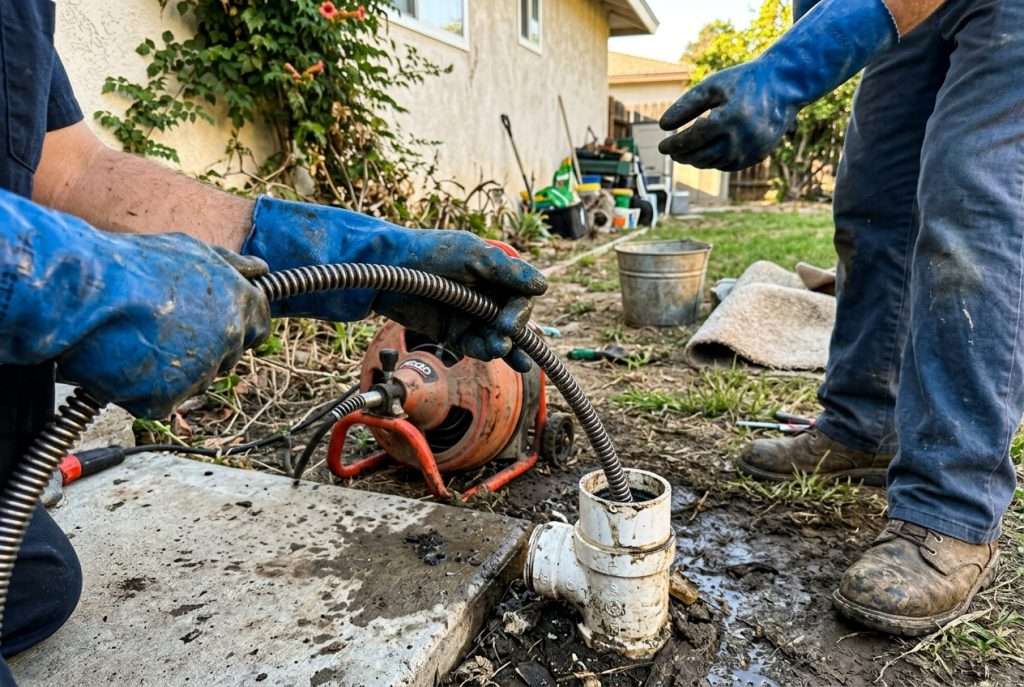
For a straightforward clog, a plumber’s snake or auger mechanically breaks through the blockage and gets water flowing again. It’s fast and affordable, and it’s the right first move for most single-fixture clogs. If the same drain keeps backing up, though, snaking alone won’t address the underlying cause.
Hydro Jetting for Recurring Clogs
Hydro jetting uses water at up to 4,000 PSI to scour the full interior of the pipe, clearing grease, roots, and scale that a snake would just push through or around. For homeowners dealing with recurring back-ups, routine hydro jetting on a set schedule is usually the most cost-effective way to stay ahead of the problem. It won’t fix a pipe that’s already cracked or collapsed, but it will buy time and keep things flowing.
When the Pipe Itself Has Failed
If tree roots have been a recurring issue or a camera inspection shows cracks, bellies, or scale that cleaning can’t remove, it’s time to talk about repair or replacement. A few options:
- Trenchless pipe lining (CIPP): A resin-saturated liner is inserted through existing access points and cured in place, creating a new pipe inside the old one without digging up your yard.
- Pipe bursting: A new HDPE pipe is pulled through the path of the old one, breaking the old pipe apart as it goes — minimal digging required.
- Traditional excavation: The old-fashioned dig-and-replace approach. More invasive and typically the most expensive option, but sometimes it’s the right call depending on pipe condition and access.
Most San Gabriel Valley homes with older cast iron or clay sewer lines are good candidates for trenchless repair, which avoids tearing up landscaping, driveways, or hardscape.
Not Sure What’s Causing Your Back Up?
A camera inspection is the fastest way to know for sure whether you’re dealing with a simple clog or a pipe that needs attention. We’re happy to take a look, walk you through what we see, and lay out your options — no pressure, no guesswork.
Call Us Anytime At: 626.448.6455
Free estimates available.