Choosing between a tank and tankless water heater affects your home’s comfort, monthly utility bills, and maintenance schedule for years to come. Pasadena homeowners face a decision that goes beyond simple preference—it requires understanding how each system performs in the San Gabriel Valley’s unique conditions, including hard water, older home infrastructure, and local climate patterns.
Traditional tank water heaters have served Southern California homes reliably for decades, storing 40 to 80 gallons of hot water ready for use. Tankless systems, also called on-demand water heaters, heat water only as you need it, eliminating the storage tank entirely. Both options work well, but the right choice depends on your household size, hot water usage patterns, budget, and home’s existing infrastructure.
The decision becomes more complex for Pasadena residents due to factors like mineral-heavy water supply, gas line capacity in older neighborhoods, and available rebate programs through local utilities. This guide examines the tank vs tankless water heater question specifically for San Gabriel Valley homeowners, addressing costs, performance, maintenance needs, and local installation requirements that directly impact your decision.
Understanding the Basics: Tank vs Tankless Water Heaters
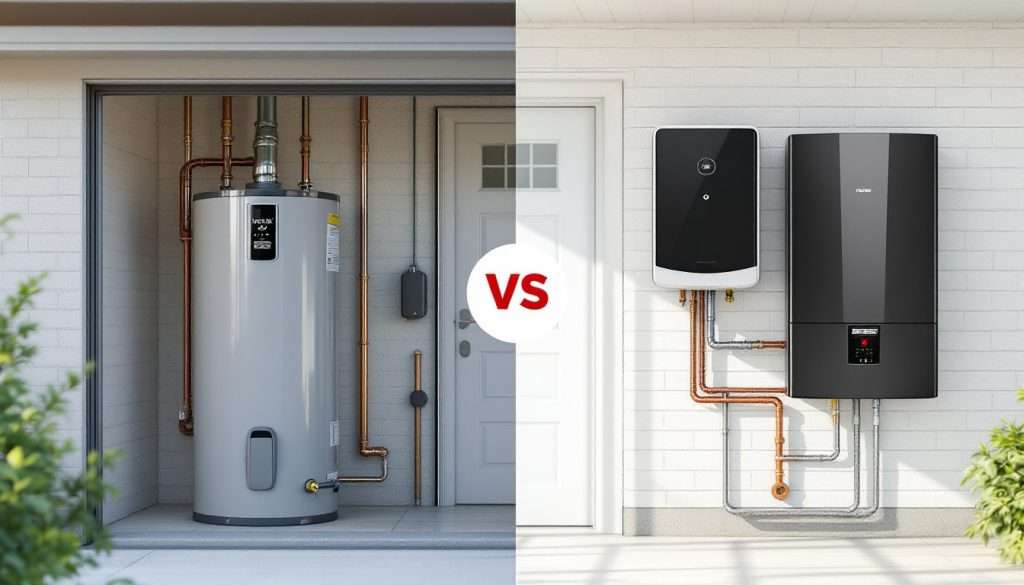
Traditional tank water heaters store heated water in an insulated reservoir, typically 40 to 80 gallons. A gas burner or electric heating element maintains water temperature around 120-140°F continuously. When you turn on a hot water tap, stored water flows out, and cold water refills the tank for the next heating cycle. These units occupy significant floor space, usually in a garage, basement, or utility closet.
Tankless water heaters operate differently. When you open a hot water tap, cold water travels through pipes into the unit, where a gas burner or electric element heats it instantly. Water flows through at rates of 2 to 5 gallons per minute, depending on unit size and fuel type. The compact wall-mounted design saves floor space, making them practical for homes with limited utility areas.
The functional difference matters most during peak usage. A tank system delivers its full stored capacity at once but runs out if demand exceeds storage. A tankless unit provides hot water continuously but may struggle to supply multiple fixtures simultaneously if undersized. Pasadena homes with multiple bathrooms often need careful sizing calculations to prevent temperature drops during simultaneous showers and laundry loads.
Recovery rate—how quickly the system heats replacement water—differs substantially. Tank heaters need 30 to 60 minutes to reheat a full tank after depletion. Tankless systems recover instantly since they heat on demand, making them advantageous for households with unpredictable usage patterns or frequent back-to-back hot water needs throughout the day.
Upfront Cost Comparison for Pasadena Homeowners
Tank water heater installation in Pasadena typically ranges from $1,200 to $2,800, including the unit, labor, permits, and basic modifications. Gas models cost more than electric versions, but natural gas prices in Southern California generally make them more economical long-term. The installation remains straightforward in most homes since tank heaters replace existing units using the same connections and venting paths.
Tankless water heater installation costs between $3,500 and $5,500 in the San Gabriel Valley. The higher price reflects more complex installation requirements: upgraded gas lines, electrical work for electronic controls, modified venting systems, and potential structural modifications for wall mounting. Professional tankless water heater installation requires specialized knowledge of local building codes and proper sizing calculations.
Additional expenses affect tankless installations more significantly. Pasadena’s older homes often need gas line upgrades to deliver adequate fuel flow, adding $500 to $1,500 to project costs. Electrical panel upgrades may be necessary for electronic ignition and control systems, particularly in homes built before 1980. Venting modifications typically cost less than tank systems since tankless units use smaller-diameter PVC pipes rather than large metal flues.
Permit fees and inspection requirements remain similar for both systems in Pasadena, usually $150 to $300. However, tankless installations receive more scrutiny from building inspectors regarding gas pressure, venting configuration, and clearance requirements. The inspection process takes longer, potentially delaying project completion by several days compared to tank replacements.
Budget-conscious homeowners should factor total installation costs into their decision. While tankless systems cost significantly more upfront, rebates and energy savings offset some of this difference over time. For transparent pricing information on both options, Western Rooter provides detailed plumbing pricing to help homeowners plan their investment accurately.
Long-Term Value: Lifespan and Energy Efficiency
Tank water heaters last 8 to 12 years under normal conditions, with lifespan affected by water quality, maintenance frequency, and usage patterns. San Gabriel Valley’s hard water accelerates sediment buildup inside tanks, potentially reducing longevity to the lower end of this range without regular flushing. Replacement becomes necessary when the tank develops leaks, which can cause significant water damage if undetected.
Tankless water heaters typically last 20 years or longer, nearly double the tank system lifespan. The absence of a storage tank eliminates corrosion and leak risks associated with traditional heaters. Internal components like heat exchangers may need replacement after 10 to 15 years, but these repairs cost less than full system replacement and extend overall unit longevity considerably.
Energy efficiency differences substantially impact operating costs. Tank heaters maintain water temperature continuously, creating standby heat loss as warmth escapes through tank walls and pipes. This constant reheating consumes energy even when no one uses hot water, particularly overnight and during work hours when homes sit empty. Energy efficiency ratings typically range from 60% to 70% for standard tank models.
Tankless systems achieve 80% to 98% energy efficiency since they heat water only on demand. Southern California Gas Company studies show tankless units reduce natural gas consumption by 24% to 34% for typical households, translating to $150 to $300 annual savings on utility bills. The energy conservation becomes more pronounced in homes with frequent vacation absences or seasonal usage patterns.
Over a 15-year period, assuming $200 annual energy savings, a tankless system offsets its higher installation cost through reduced utility bills and longer lifespan. The calculation becomes more favorable with rising energy prices and when factoring avoided replacement costs for a second tank heater during the same timeframe that one tankless unit operates.
Space Requirements and Installation Considerations
Tank water heaters require 16 to 20 square feet of floor space for proper installation and necessary clearances. Standard 50-gallon models stand about 5 feet tall and 2 feet in diameter, demanding vertical clearance for top-mounted venting systems. Pasadena homes with finished garages or converted utility spaces often struggle to accommodate these dimensions while maintaining required clearances from walls, doors, and combustible materials.
Tankless units measure roughly 2 feet tall by 1.5 feet wide and 10 inches deep, mounting on exterior or interior walls. The compact design frees valuable floor space for storage or other uses, particularly beneficial in older Pasadena homes where square footage comes at a premium. Wall mounting also protects the unit from potential flood damage, a consideration for homes in areas prone to water intrusion during heavy rainfall.
Installation location flexibility differs between systems. Tank heaters must sit on level floors with adequate drainage capacity in case of leaks. Tankless units can mount in various locations—garages, exterior walls, utility closets, or even under-sink installations for point-of-use applications. This flexibility allows strategic placement closer to high-demand fixtures, reducing wait times for hot water delivery.
Venting requirements influence installation complexity. Tank heaters typically use Type B metal vents routing through the roof, requiring substantial attic access and potential roof modifications. Tankless systems use PVC or stainless steel venting that exits through sidewalls, simplifying installation and reducing costs. However, exterior venting placement must comply with Pasadena building codes regarding clearances from windows, doors, and property lines.
Homeowners planning renovations or additions should consider how each system type affects available space. Tankless installations maximize usable square footage, allowing utility closets to serve dual purposes or be eliminated entirely. The space savings becomes particularly valuable during home sales, as buyers increasingly value efficient use of every square foot in the competitive Pasadena real estate market.
Hard Water Impact in the San Gabriel Valley
Pasadena’s water supply contains high mineral concentrations, particularly calcium and magnesium, creating hard water conditions throughout the San Gabriel Valley. These minerals precipitate out of solution when heated, forming scale deposits that accumulate inside water heaters. The scaling process affects both tank and tankless systems but creates different maintenance challenges for each type.
Tank water heaters accumulate sediment at the bottom of the storage reservoir, reducing heating efficiency and available hot water capacity. A half-inch layer of sediment can decrease efficiency by 15% to 20%, forcing the heating element to work harder and increasing energy costs. Annual flushing removes accumulated sediment, but many homeowners neglect this maintenance until performance degrades noticeably or the tank fails prematurely.
Tankless systems face more severe consequences from hard water. Scale buildup inside the heat exchanger reduces thermal transfer efficiency and restricts water flow through narrow passages. Severe scaling can trigger error codes, reduce hot water temperature, or cause complete system failure. The compact design that makes tankless units space-efficient also makes them more vulnerable to mineral accumulation in critical components.
Professional descaling service becomes necessary for tankless heaters every 1 to 2 years in the San Gabriel Valley, costing $150 to $250 per service. The process involves circulating acidic cleaning solution through the heat exchanger to dissolve mineral deposits. Skipping this maintenance voids most manufacturer warranties and leads to expensive repairs or premature system replacement, potentially eliminating the longevity advantage tankless units normally provide.
Water softening or filtration systems effectively protect both heater types from hard water damage. Installing a whole-house water filtration system removes minerals before they reach the water heater, extending equipment lifespan and reducing maintenance frequency. The combined investment in water treatment and a tankless heater costs more initially but preserves system efficiency and prevents costly scale-related failures.
Arcadia and other San Gabriel Valley communities face similar hard water challenges, making water quality management an important consideration regardless of water heater type. Homeowners should test their water hardness levels and discuss protection strategies with qualified plumbers familiar with local water conditions and their impact on plumbing systems.
Gas Line Requirements for Older Pasadena Homes
Pasadena’s historic neighborhoods contain homes built between the 1920s and 1960s with gas lines sized for appliances of that era. These older systems used smaller-diameter pipes—often 1/2 inch or 3/4 inch—adequate for tank water heaters and traditional appliances but insufficient for high-demand tankless units. Modern tankless heaters require substantial gas flow rates, typically 150,000 to 200,000 BTUs, to heat water instantaneously.
Gas line capacity calculations consider pipe diameter, length, number of fittings, and total BTU demand from all appliances. A tankless water heater may require a dedicated 3/4-inch or 1-inch gas line running directly from the meter to ensure adequate pressure and flow. Homes in Old Pasadena, Bungalow Heaven, and similar historic districts often need extensive gas line upgrades before tankless installation becomes feasible.
The upgrade process involves licensed plumbers assessing current gas infrastructure, calculating demand loads, and sizing new pipes appropriately. In some cases, the gas meter itself requires replacement to support increased flow capacity, requiring coordination with Southern California Gas Company. These modifications add $800 to $2,000 to installation costs, sometimes making tankless systems less economical despite long-term energy savings.
Permit requirements for gas line modifications in Pasadena are strict, requiring licensed contractors with specific gas certification. Inspectors verify proper pipe sizing, secure connections, pressure testing, and leak detection before approving installations. The permitting process takes several weeks, extending project timelines beyond simple tank heater replacements.
Tank water heaters typically work with existing gas lines in older homes since their lower BTU demand—usually 30,000 to 50,000 BTUs—remains within the capacity of original piping. This compatibility makes tank heaters the practical choice for budget-conscious homeowners who want to avoid gas infrastructure upgrades, particularly in homes where other major renovations aren’t planned.
Homeowners considering tankless systems should request professional gas line assessments before committing to installation. Qualified Pasadena plumbing specialists can evaluate existing infrastructure, provide accurate upgrade cost estimates, and help determine whether tankless installation makes financial sense for specific properties based on their gas system configuration.
Available Rebates and Incentives in California
Southern California Gas Company offers rebates for high-efficiency water heaters through its Energy Savings Assistance Program. Qualified income-eligible customers can receive rebates up to $500 for tankless water heater installations that meet ENERGY STAR certification requirements. These rebates directly reduce upfront installation costs, making tankless systems more accessible to homeowners who would benefit most from long-term energy savings.
California’s State Water Efficiency and Enhancement Program provides additional incentives for water-heating equipment upgrades that reduce both energy and water consumption. Tankless systems typically qualify since they eliminate standby heat loss and can be paired with recirculation systems that minimize water waste while waiting for hot water delivery. Rebate amounts vary based on specific equipment installed and project scope.
Federal tax credits for energy-efficient home improvements may apply to qualifying water heater installations. The Inflation Reduction Act extended and expanded these credits, offering up to 30% of installation costs for systems meeting specified efficiency standards. Tankless gas water heaters with Uniform Energy Factor (UEF) ratings of 0.95 or higher typically qualify, while tank heaters rarely meet the threshold.
Local utility programs change periodically, making it important to verify current offerings before making purchase decisions. Pasadena residents should check SoCalGas.com and consult with installation contractors familiar with available programs. Many plumbing companies assist with rebate applications, providing necessary documentation and ensuring installations meet qualification requirements.
The combined effect of multiple rebate programs can reduce tankless system costs by $800 to $1,500, significantly narrowing the price gap with tank heaters. Homeowners should factor these incentives into total cost comparisons and consider timing installations to align with program availability. For detailed information about qualifying systems and installation requirements, the tankless FAQ answers common questions about rebates and efficiency standards.
Conclusion
The tank vs tankless water heater decision for Pasadena homes depends on budget, usage patterns, home infrastructure, and long-term planning. Tank heaters offer lower upfront costs and straightforward installation in most homes, working reliably with existing gas lines and electrical systems. Tankless systems provide superior energy efficiency, longer lifespan, and space savings but require higher initial investment and potential infrastructure upgrades.
Pasadena’s hard water conditions affect both systems but demand different maintenance approaches. Homeowners must commit to regular descaling service for tankless units or risk premature failure and voided warranties. Water treatment systems protect either heater type while improving overall plumbing system longevity. Older homes in historic neighborhoods face gas line limitations that may make tank heaters more practical unless comprehensive renovations justify infrastructure upgrades.
Rebate programs and energy savings help offset tankless systems’ higher costs over time, particularly for households with high hot water usage and homes where longevity and efficiency are priorities. The 20-year lifespan and reduced utility bills create compelling long-term value despite demanding more upfront investment. Budget-conscious homeowners with near-term replacement needs may find tank heaters more appropriate, deferring tankless consideration to future replacement cycles.
Western Rooter & Plumbing helps San Gabriel Valley homeowners evaluate water heater options based on their specific properties, usage patterns, and budgets. Professional assessment of gas line capacity, water quality, and installation requirements ensures accurate cost estimates and realistic performance expectations. Choosing the right system requires understanding how local factors—from mineral content to building codes—affect equipment performance and longevity.
Whether you select a tank or tankless system, proper installation and regular maintenance protect your investment and ensure reliable hot water for years ahead. Contact Western Rooter to schedule a consultation, discuss your home’s specific requirements, and receive expert recommendations tailored to Pasadena’s unique conditions and your household needs.